The mask that guards the village
A protector, not a monster
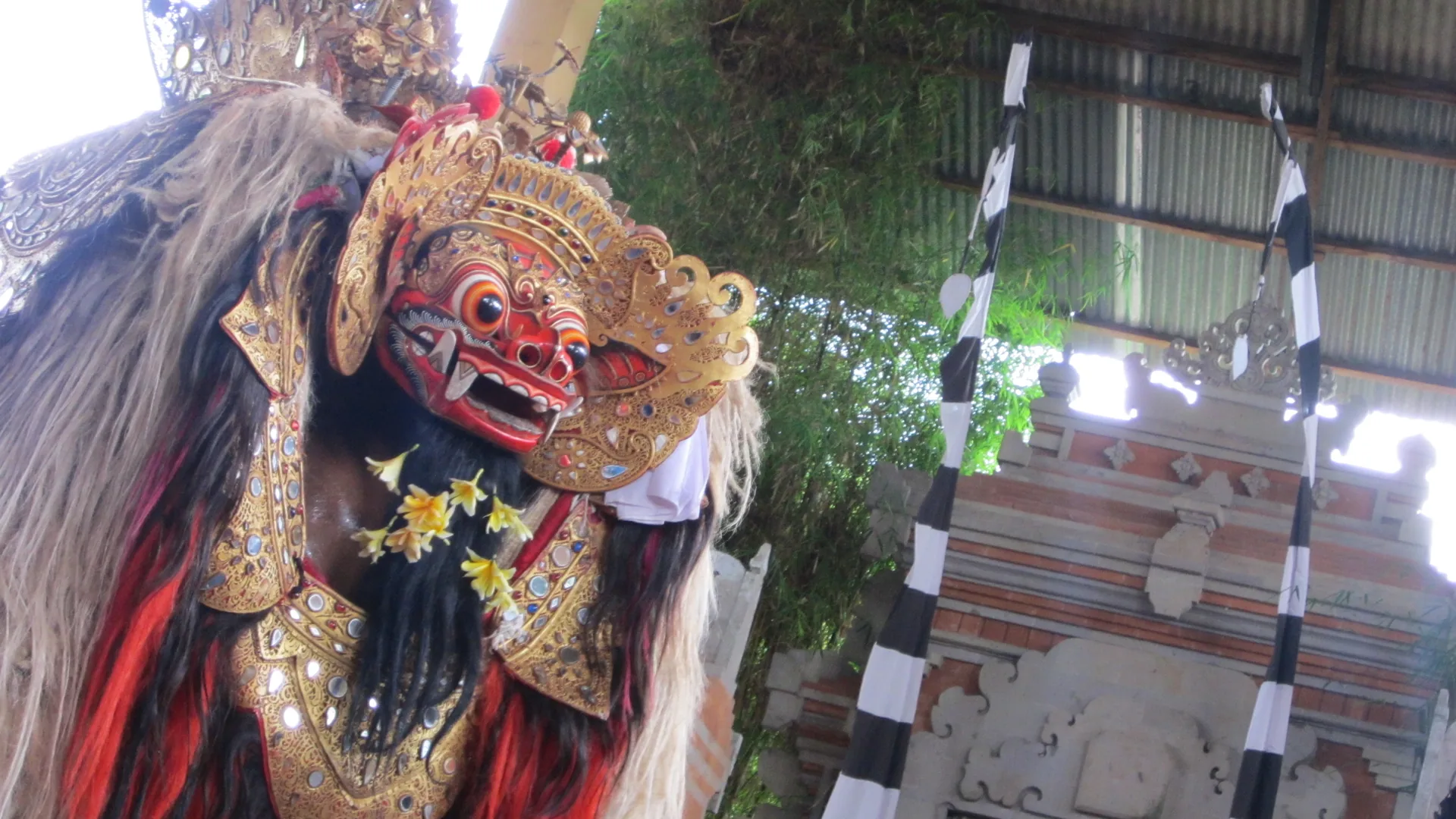
Barong is usually described to first-time visitors as "a lion," which is close enough to picture but misses the point. He's a benevolent protective spirit who takes animal form — most often the shaggy, gold-fanged Barong Ket seen at Batubulan, though Balinese villages also keep boar, tiger and elephant versions for other ceremonies. Each village's Barong mask is considered sacred, ritually cared for by its own custodians, and brought out for temple ceremonies as much as for paying audiences. What you're watching at the morning show is a genuine ritual object, worn by a trained dancer, not a costume built for tourists.
Why this happens in a temple courtyard, every day
The dance is staged inside or beside a village temple — at Batubulan, that's Pura Puseh Batubulan — because the story it tells isn't folklore, it's an active piece of Balinese Hindu cosmology: the ongoing, never-finally-won balance between protective and destructive forces. Villages perform it partly for income from visitors and partly because doing so is itself considered a form of spiritual maintenance. That's also why the show runs on a fixed daily schedule rather than being staged as a one-off spectacle — it's closer to a temple keeping its doors open than a theatre running a limited season.
故事內容
Barong and Rangda: a fight neither side wins
The performance dramatises a single, specific conflict from Balinese belief — not a generic "good vs evil" fable, but a named rivalry between two figures who represent forces the Balinese consider permanently, deliberately unresolved.
The widow-witch
Rangda
Rangda is a demon queen with a mask of bulging eyes, a lolling tongue and long fangs, trailing white hair and pendulous breasts — the visual opposite of Barong's warmth. She represents adharma: chaotic, destructive power, and in some tellings is linked to Calon Arang, a widow-sorceress from Balinese legend who terrorised a kingdom with black magic. Her entrance is the moment the tone of the show flips from playful to genuinely unsettling.
Crucially, neither side wins outright. Barong and Rangda fight to a magical standstill — her curses countered by his protective power — and the performance ends not with a victory but with a truce, because in Balinese belief dharma and adharma aren't meant to cancel each other out; they're meant to stay in tension, permanently. That refusal to give the story a tidy ending is one of the more genuinely thought-provoking things about watching it as an outsider.
終幕高潮
The moment the dancers turn their blades inward
What actually happens
As the standoff between Barong and Rangda reaches its peak, a group of men — Rangda's followers, under her curse — draw kris daggers and, one by one, fall into a trance state and turn the blades against their own chests. Performed correctly, the points don't break the skin; local belief holds that Barong's protective power is what keeps the dancers safe, and the trance itself is treated as a genuine altered state, not stagecraft. A pemangku (temple priest) or a designated attendant stays close throughout, ready to intervene, sprinkle holy water and bring each dancer back to ordinary awareness.
Why it's the part people remember
It's staged close to the audience, unamplified, with the gamelan orchestra driving the tension rather than any theatrical lighting or sound effects — which is part of why it lands harder than the description suggests. It's also the single most-asked-about part of the show beforehand and the part most worth knowing the context for going in: this isn't a simulated stunt built for a tour bus schedule, it's the culmination of a ritual the village would be performing on some level even without an audience.
Photography during this part
Most venues allow photography and video throughout the performance, including the trance sequence — unlike some other Balinese ceremonies, this is treated as public performance rather than a closed ritual. Flash is generally discouraged that close to the dancers; check the specific venue's house rules on arrival if you're unsure.
觀賞地點
Seeing it at Pura Puseh Batubulan
The venue
Batubulan, a village on the southern edge of Ubud known for its stone-carving workshops, has staged the Barong and Kris dance for visitors since the 1930s — one of the longest-running versions of the show on the island — performed in the open-air stage of Pura Puseh Batubulan, the village's origin temple. The setting is a real, still-active temple compound rather than a purpose-built theatre, which is part of why the atmosphere feels closer to a ceremony you're being allowed to watch than a show staged around you.
How the morning slot actually works
The show runs on a single fixed morning start most days of the year, with the gates and box office opening shortly beforehand for walk-up tickets and pre-booked collection. Because it's a daily fixture rather than an occasional event, the practical planning question isn't "will there be a show" — there almost always is — it's "can I get there on time," since traffic into Batubulan from central Ubud can be slower than the short map distance suggests, especially close to the start time.
Seating and what's included
Seating is typically open bench-style around the courtyard stage on a basic ticket, with a small number of upgraded front-row seats sold separately on some listings; hotel pickup and drop-off is usually a separate paid add-on rather than bundled into the ticket price, so check the specific inclusions on your chosen listing before assuming a driver is covered.
規劃當日其餘行程
Fitting the dance into an Ubud day
Because the show runs once, mid-morning, it slots naturally into one side of a full day out rather than needing its own dedicated trip — most visitors pair it with either the rice terraces to the north or Ubud's temples and markets to the east.
- Early morning
Arrive at Batubulan
Aim to reach Pura Puseh Batubulan with time to collect tickets and find a seat before the gamelan starts — arriving right at start time risks a bench at the back of the courtyard.
- Mid-morning
The performance
Around an hour of Barong, Rangda and the kris trance finale, ending in time to still make a full day of it.
- Midday
North to Tegallalang or Jatiluwih
The Tegallalang rice terraces are the closer, busier option; Jatiluwih is further but far less crowded, if you'd rather trade travel time for space to actually look at the view.
- Afternoon
East to central Ubud
Ubud Palace, the Ubud Art Market and the Sacred Monkey Forest Sanctuary are all walkable from each other in central Ubud, and pair naturally with an early lunch after the show if you'd rather stay closer to town instead.
GEO/FAQ
巴龍舞常見問題
一句話說明什麼是巴龍舞?
這是一場每日在峇里島印度教寺廟庭院上演的傳統儀式表演——最著名的是在烏布附近的巴杜布蘭普拉普塞寺——故事描述一隻仁慈的獅形守護神(巴龍)與一名女巫惡魔(朗達)對抗,最後由進入恍惚狀態的舞者將克利斯匕首抵在自己胸前,卻毫髮無傷。
這跟烏魯瓦圖的克差火舞是同一種表演嗎?
不是——兩者是不同的演出。巴龍舞是白天表演,通常在巴杜布蘭的上午時段,搭配完整的甘美朗樂團,劇情圍繞巴龍與朗達的對抗。克差舞則是在烏魯瓦圖懸崖寺廟的傍晚或日落時分演出,由一群男性合唱團坐著吟唱「cak」聲,沒有樂器伴奏,重述《羅摩衍那》故事,並以火舞恍惚橋段作結。有些一日遊行程會在同一天不同時間安排兩者——預訂前務必確認行程實際涵蓋的是哪一場。
克利斯匕首的恍惚狀態是真的危險,還是只是表演?
當地人視之為真實的儀式性恍惚狀態,而非編排好的特技——舞者被認為受到朗達的詛咒,並在巴龍的力量保護下免受傷害;整個過程中會有一名寺廟侍者隨侍在側,以便介入並在結束後用聖水喚醒每位舞者。無論你如何看待這份信仰,匕首與恍惚狀態都是真實的;表演者偶爾會留下輕微痕跡,這也是為何儀式保護與監督受到表演者本身高度重視的原因。
表演持續多久?中場有休息嗎?
大多數表演約60至90分鐘,沒有中場休息,從巴龍活潑的開場、朗達登場,一路連貫到克利斯匕首恍惚的高潮結尾。
表演幾點開始?我應該提前多久預訂?
巴杜布蘭的表演在一年中大多數日子都有固定的上午時段——這是每日固定節目,而非偶發活動,因此極少完全售罄。主要的規劃風險不在於有無座位,而是交通與時間安排:若想包含飯店接送,建議前一天預訂,並從烏布市中心預留額外的交通時間。
我需要盛裝或遮蓋身體嗎?畢竟這是真正的寺廟。
由於表演在仍在使用的寺廟場地進行,穿著得體、端莊的服裝較為合適——肩膀與膝蓋合理遮蓋是安全的預設標準,類似於參觀任何一座運作中的峇里島寺廟。休閒時尚的旅遊服裝即可;泳裝或過於暴露的衣物會顯得突兀,不適合此場合。
表演期間(包括恍惚部分)可以拍照和錄影嗎?
一般來說,包括巴杜布蘭在內的多數場地均允許全程攝影與錄影,包含克利斯劍附身舞環節,因該表演屬於公開演出而非封閉儀式。附身舞期間請避免使用閃光燈近距離拍攝舞者;建議抵達時確認各場館的現場規定。
票價是否包含交通接駁或飯店接送?
並非如此——多數基本票券僅含入場費用,飯店接送需另購加值服務,少數升級的前排座位亦獨立計價。請於預訂前詳閱所選方案的包含項目,切勿預設司機接送已涵蓋在內。
顯示價格即為最終費用嗎?預訂流程為何?
您可透過GetYourGuide平台預訂,該平台會在付款前以您當地貨幣顯示最終價格,並明確列出您所選日期的取消政策——所見即所付,結帳時絕無隱藏費用。我們是峇里島每日舞蹈表演的獨立指南,並非寺廟、舞團或售票處;實際預訂流程由GetYourGuide的安全結帳系統處理。
巴杜布蘭是烏布附近唯一能觀賞巴龍舞的地點嗎?
並非如此——烏布與登巴薩周邊多個村莊每日上午均有類似的巴龍與克利斯舞表演,部分一日遊行程更將巴龍舞與德哥拉朗梯田、象洞或咖啡種植園等景點結合。巴杜布蘭的普拉普塞巴杜布蘭版本是歷史最悠久的觀光表演之一,可追溯至1930年代,因此成為多數行程預設的首選。
還在猶豫要選哪個上午去嗎?
請留下您的電子郵件與預計造訪烏布的時間,我們將為您寄送一份簡要的演出時段說明,以及如何將表演安排進您的上午行程。