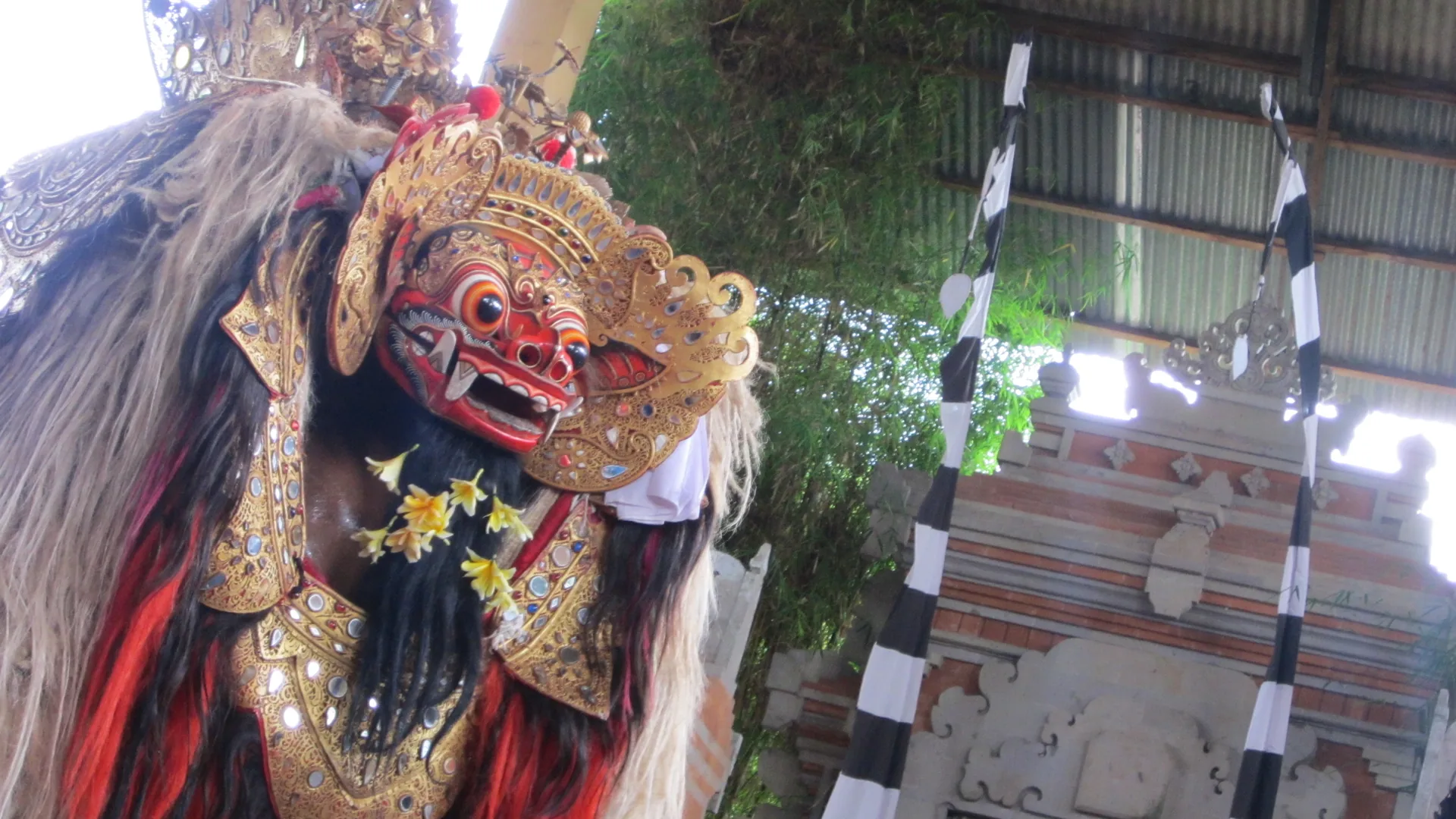
La màscara que protegeix el poble
A protector, not a monster
Normalment es descriu el Barong als qui hi van per primera vegada com "un lleó", cosa que s'acosta prou per imaginar-se'l però no capta l'essència. És un esperit protector benèfic que adopta forma animal — sovint el pelut Barong Ket de dents daurades que es veu a Batubulan, tot i que els pobles balinesos també conserven versions de senglar, tigre i drac per a altres cerimònies. El Barong el ballen dos intèrprets que treballen junts, amb un vestuari de pell blanca espessa decorat amb or i peces de mirall. El que veus en un espectacle per a visitants és una representació escenificada d'aquesta tradició.
Per què la dansa es representa cada dia
Els pobles de tot Bali representen la dansa Barong, i el lloc web de turisme d'Indonèsia assenyala Batubulan, a Gianyar, i Kesiman, a Denpasar, com els llocs més populars per veure-la. Batubulan té diversos escenaris: un és al costat de Pura Puseh Batubulan, i l'escenari d'aquesta reserva és Seraya Budaya. La història és una batalla entre el bé i el mal, el Barong contra Rangda, i la dansa es representa diàriament per als visitants.
La història
Barong i Rangda: el bé contra el mal
L'espectacle dramatitza un conflicte de la creença balinesa entre dues figures: el Barong, un esperit protector semblant a un lleó, i Rangda, la reina de les bruixes.
The widow-witch
Rangda
La Rangda és una reina dimoni amb una màscara d'ulls sortits, llengua penjant i ullals llargs, cabells blancs esfilagarsats i pits caiguts — el contrari visual de la calidesa del Barong. Representa l'adharma: el poder caòtic i destructiu, i en algunes versions s'associa amb Calon Arang, una vídua fetillera de la llegenda balinesa que va terroritzar un regne amb màgia negra. La seva entrada és el moment en què el to de l'espectacle passa de juganer a autènticament inquietant.
Com acaba depèn de la companyia i de la història. Wikipedia i el lloc web de turisme d'Indonèsia presenten el Barong derrotant Rangda i restaurant l'equilibri; la premsa indonèsia que descriu un espectacle a Batubulan diu que la lluita mai no acaba amb una victòria clara. En qualsevol cas, el tema és l'equilibri entre el bé i el mal.
El final
El moment en què els ballarins giren les fulles cap a dins
What actually happens
Quan l'enfrontament entre el Barong i Rangda arriba al seu punt àlgid, els homes que representen els soldats del rei Airlangga treuen punyals kris. A la història, la màgia de Rangda els empeny a girar les fulles contra el seu propi pit; cauen en trànsit, i la màgia protectora del Barong i d'un sacerdot els deixa il·lesos. L'aigua beneïda els treu del trànsit. Com representa aquesta escena cada escenari varia: una nota d'un fotògraf a Wikimedia Commons sobre un escenari turístic de Batubulan descriu l'apunyalament com a simulat.
Per què és la part que la gent recorda
És útil conèixer el context d'entrada: l'escena pertany a una tradició ritual, però un espectacle per a visitants és una representació, i com de literalment es posa en escena el trànsit depèn de l'escenari.
Fotografia durant aquesta part
La reserva inclou una càmera entre les coses que cal portar. Les normes sobre flaix i filmació en un escenari no es publiquen a les fonts que hem trobat, així que pregunta a l'equip en arribar si tens dubtes.
On veure'l
Veure-ho a Seraya Budaya
The venue
Batubulan és un poble de Gianyar conegut pel seu ball de Barong i Kris, que es representa en diversos espais. El punt de trobada d'aquesta reserva és Seraya Budaya, un escenari que els llocs de venda d'entrades situen a Singapadu, districte de Sukawati, Gianyar. Altres escenaris de Batubulan inclouen un al costat de Pura Puseh Batubulan i Jambe Budaya, cadascun amb la seva pròpia companyia.
Com funciona la reserva
El calendari de reserves i la teva confirmació mostren l'hora d'inici per a la teva data. Si has triat recollida, l'equip et recull; si has triat sense trasllat, bescanvies el teu e-voucher per una entrada amb l'equip a l'espai.
Seients i què s'inclou
L'entrada inclou l'espectacle. La recollida i el retorn, i la Silver Class, només s'inclouen si selecciones aquestes opcions; la descripció de l'opció a la teva data indica què canvia la Silver Class.
Reserveu amb confiança
Troba una entrada per a la dansa Barong & Kris per a les teves dates
Totes les opcions següents es poden reservar a través de GetYourGuide, amb disponibilitat en temps real i el preu final mostrat en la teva moneda abans de pagar.
- Reserva ara, paga després Reserva ara la teva plaça per al ball de Barong i Kris a Batubulan i no paguis res avui, ho pots liquidar més endavant.
- Condicions de cancel·lació per endavant La data límit exacta de cancel·lació per a la data que trieu s'indica a la pàgina de pagament de GetYourGuide abans que introduïu cap dada de pagament
- Sense càrrecs ocults El que veus per a la teva localitat de Barong és exactament el que cobra GetYourGuide, sense sorpreses al moment de pagar
- Pagament segur Reservat a través del pagament protegit de GetYourGuide
Planificant la resta del dia
Encaixar la dansa en un dia a Ubud
Com que l'espectacle és una única representació, encaixa de manera natural en una part d'un dia complet en lloc de necessitar un viatge dedicat — la majoria de visitants el combinen amb els arrossars al nord o amb els temples i mercats d'Ubud a l'est.
- Abans de l'espectacle
Arrive at Batubulan
Intenta arribar a Seraya Budaya amb prou temps per bescanviar el teu voucher (si has triat sense trasllat) i trobar seient abans que comenci el gamelan.
- Hora de l'espectacle
The performance
Prop d'una hora de Barong, Rangda i l'escena del kris.
- Després de l'espectacle
North to Tegallalang or Jatiluwih
Els arrossars de Tegallalang són l'opció més propera i concorreguda; Jatiluwih queda més lluny però està molt menys massificat, si prefereixes canviar temps de desplaçament per espai per contemplar realment les vistes.
- Més tard
East to central Ubud
El Palau d'Ubud, el Mercat d'Art d'Ubud i el Santuari del Bosc dels Micos Sagrats es troben al centre d'Ubud, si preferiu allotjar-vos més a prop del poble després de l'espectacle.
GEO/FAQ
Preguntes sobre la dansa Barong
Què és la dansa Barong, en una frase?
És un drama de dansa balinesa diari amb arrels rituals, representat en escenaris dels voltants de Batubulan, a Gianyar, en què un esperit guardià benèvol semblant a un lleó (Barong) s'enfronta a una bruixa dimoni (Rangda), amb una escena en què els ballarins en trànsit es giren kris (punyals) contra si mateixos.
És el mateix que el ball del foc Kecak a Uluwatu?
No — són dos espectacles diferents. El Barong es representa diàriament en escenaris dels voltants de Batubulan, amb música de gamelan i una trama de Barong contra Rangda. El Kecak és un espectacle nocturn o al capvespre al temple penya-segat d'Uluwatu, interpretat íntegrament per un cor masculí assegut que canta "cak" sense instruments, que relata el Ramayana i acaba amb una seqüència de trànsit i foc. Alguns itineraris d'excursions d'un dia inclouen tots dos el mateix dia a hores diferents — val la pena comprovar quin dels dos cobreix realment una oferta abans de reservar.
El tràngol del kris és perillós o està escenificat?
En la història, els ballarins estan en trànsit, protegits del mal per la màgia del Barong, i l'aigua beneïda els retorna. Com representa l'escena cada escenari varia: la nota d'un fotògraf d'un escenari turístic de Batubulan descriu l'apunyalament com a simulat, i Wikipedia registra un accident mortal en una representació del 2021 a Denpasar. Tracteu-ho com una dansa que implica punyals.
Quant dura l'espectacle i hi ha entreacte?
Els informes dels espectacles de Batubulan indiquen aproximadament una hora. La vostra confirmació mostra l'hora d'inici.
A quina hora comença l'espectacle i amb quanta antelació hauria de reservar?
El calendari de reserves i la vostra confirmació mostren l'hora d'inici per a la vostra data. Cap font que hem trobat indica amb quina freqüència s'esgoten les dates, així que reservar amb antelació amb l'opció de reservar ara i pagar després i cancel·lació gratuïta fins a 24 hores abans (quan reserveu a través de GetYourGuide) és l'opció de baix risc.
Cal que vagi mudat o que em tapi?
La reserva demana roba i calçat còmodes i no estableix cap codi de vestimenta. L'oficina de turisme d'Indonèsia indica cobrir espatlles i genolls com a regla general en recintes de temples, així que és l'opció segura si el vostre escenari és al costat d'un temple.
Puc fer fotos i vídeo durant l'espectacle, incloent-hi la part del tràngol?
La reserva inclou una càmera entre les coses que cal portar. Les normes sobre flaix i filmació en un escenari no es publiquen a les fonts que hem trobat, així que pregunteu a l'equip en arribar.
El transport o la recollida a l’hotel estan inclosos al preu de l’entrada?
No, tret que ho seleccioneu. La reserva inclou l'entrada, amb recollida i retorn i Classe Silver inclosos només si seleccioneu aquestes opcions.
El preu que es mostra és el final? Com funciona la reserva?
La reserva es fa a través de GetYourGuide, que mostra el preu final en la vostra moneda abans de pagar i indica la política de cancel·lació per a la data concreta de manera transparent. El preu que veieu és el que pagueu, sense despeses ocultes en finalitzar la compra. Som una guia independent de les danses diàries de Bali, no el temple, la companyia ni la taquilla; la reserva es gestiona mitjançant el sistema de pagament segur de GetYourGuide.
Batubulan és l’únic lloc on es pot veure la dansa Barong prop d’Ubud?
No. El lloc de turisme d'Indonèsia esmenta Batubulan, a Gianyar, i Kesiman, a Denpasar, com a llocs populars per a les representacions de Barong dels vilatans, i Batubulan mateix té diversos escenaris. L'escenari d'aquesta reserva és Seraya Budaya.