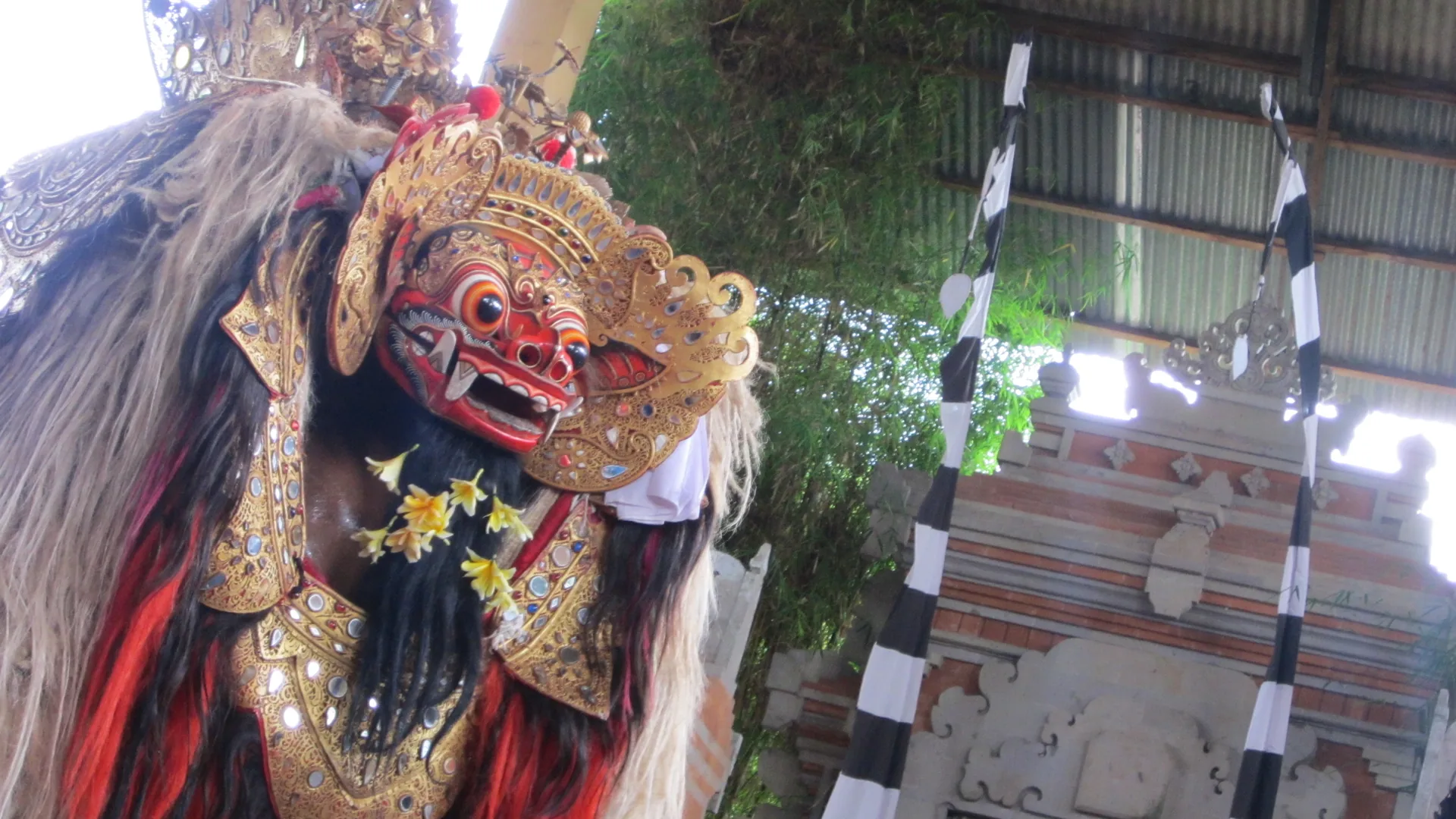
The mask that guards the village
A protector, not a monster
Barong is usually described to first-time visitors as "a lion," which is close enough to picture but misses the point. He's a benevolent protective spirit who takes animal form — most often the shaggy, gold-fanged Barong Ket seen at Batubulan, though Balinese villages also keep boar, tiger and dragon versions for other ceremonies. The Barong is danced by two performers working together, in a costume of thick white fur decorated with gold and mirror pieces. What you watch at a show for visitors is a staged performance of that tradition.
Why the dance is staged every day
Villages across Bali stage the Barong dance, and Indonesia's tourism site names Batubulan in Gianyar and Kesiman in Denpasar as the most popular places to see it. Batubulan has several stages: one sits beside Pura Puseh Batubulan, and the stage on this booking is Seraya Budaya. The story is a battle between good and evil, the Barong against Rangda, and the dance is staged daily for visitors.
The story
Barong and Rangda: good against evil
The performance dramatises a conflict from Balinese belief between two figures: the Barong, a protective lion-like spirit, and Rangda, the queen of the witches.
The widow-witch
Rangda
Rangda is a demon queen with a mask of bulging eyes, a lolling tongue and long fangs, trailing white hair and pendulous breasts — the visual opposite of Barong's warmth. She represents adharma: chaotic, destructive power, and in some tellings is linked to Calon Arang, a widow-sorceress from Balinese legend who terrorised a kingdom with black magic. Her entrance is the moment the tone of the show flips from playful to genuinely unsettling.
How it ends depends on the troupe and the story. Wikipedia and Indonesia's tourism site have the Barong defeating Rangda and restoring balance; Indonesian press describing a Batubulan show says the fight never ends in a clear victory. Either way, the theme is the balance between good and evil.
The finale
The moment the dancers turn their blades inward
What actually happens
As the standoff between Barong and Rangda reaches its peak, men who represent King Airlangga's soldiers draw kris daggers. In the story, Rangda's magic drives them to turn the blades on their own chests; they fall into a trance, and protective magic from the Barong and a priest leaves them unhurt. Holy water brings them out of the trance. How a given stage performs the scene varies: a photographer's note on Wikimedia Commons from a Batubulan tourist stage describes the stabbing as simulated.
Why it's the part people remember
It helps to know the context going in: the scene belongs to a ritual tradition, but a show for visitors is a performance, and how literally the trance is staged depends on the stage.
Photography during this part
The booking lists a camera among the things to bring. Rules on flash and filming at a stage are not published in the sources we found, so ask the team on arrival if you are unsure.
Where to see it
Seeing it at Seraya Budaya
The venue
Batubulan is a village in Gianyar known for its Barong and Kris dance, which is staged at several venues. The meeting point on this booking is Seraya Budaya, a stage that ticket sites list in Singapadu, Sukawati district, Gianyar. Other Batubulan stages include one beside Pura Puseh Batubulan and Jambe Budaya, each with its own troupe.
How the booking works
The booking calendar and your confirmation show the start time for your date. If you chose pickup, the team collects you; if you chose no transfer, you exchange your e-voucher for a ticket with the team at the venue.
Seating and what's included
The entry ticket includes the show. Pickup and drop-off, and Silver Class, are included only if you select those options; the option description on your date says what Silver Class changes.
Book with confidence
Find a Barong & Kris dance ticket for your dates
Every Barong & Kris show and add-on below runs through GetYourGuide's checkout, with live seat counts and the total in your currency shown before you confirm.
- Reserve now, pay later Reserve your seat for the Barong & Kris dance in Batubulan now and pay nothing today, settling later.
- Cancellation terms upfront The exact cancellation cut-off for your chosen date is stated on GetYourGuide's checkout page before you enter any payment details
- No hidden fees What you see for your Barong seat is exactly what GetYourGuide charges, no surprises at checkout
- Secure checkout Booked through GetYourGuide's protected payment
Planning the rest of the day
Fitting the dance into an Ubud day
Because the show is a single performance, it slots naturally into one side of a full day out rather than needing its own dedicated trip — most visitors pair it with either the rice terraces to the north or Ubud's temples and markets to the east.
- Before the show
Arrive at Batubulan
Aim to reach Seraya Budaya in good time to exchange your voucher (if you chose no transfer) and find a seat before the gamelan starts.
- Show time
The performance
About an hour of Barong, Rangda and the kris scene.
- After the show
North to Tegallalang or Jatiluwih
The Tegallalang rice terraces are the closer, busier option; Jatiluwih is further but far less crowded, if you'd rather trade travel time for space to actually look at the view.
- Later on
East to central Ubud
Ubud Palace, the Ubud Art Market and the Sacred Monkey Forest Sanctuary are in central Ubud, if you would rather stay closer to town after the show.
GEO/FAQ
Barong dance questions
What is the Barong dance, in one sentence?
It's a daily Balinese dance drama with ritual roots, staged at venues around Batubulan in Gianyar, in which a benevolent lion-like guardian spirit (Barong) confronts a demon-witch (Rangda), with a scene in which entranced dancers turn kris daggers on themselves.
Is this the same as the Kecak fire dance at Uluwatu?
No — they're two different performances. Barong is staged daily at venues around Batubulan, with gamelan music and a Barong-vs-Rangda storyline. Kecak is an evening or sunset show at the Uluwatu cliff temple, performed entirely by a seated male chorus chanting "cak" with no instruments, retelling the Ramayana and ending in a fire-trance sequence. Some day-tour itineraries include both on the same day at different times — worth checking which one a listing actually covers before booking.
Is the kris trance dangerous, or is it staged?
In the story, the dancers are in a trance, protected from harm by the Barong's magic, and holy water brings them back. How a stage performs the scene varies: a photographer's note from one Batubulan tourist stage describes the stabbing as simulated, and Wikipedia records a fatal accident at a 2021 performance in Denpasar. Treat it as a dance that involves daggers.
How long does the show last, and is there an interval?
Reports of Batubulan shows give about an hour. Your confirmation shows the start time.
What time does the show start, and how far ahead should I book?
The booking calendar and your confirmation show the start time for your date. No source we found says how often dates sell out, so booking ahead with reserve now, pay later and free cancellation up to 24 hours before (when you book through GetYourGuide) is the low-risk choice.
Do I need to dress up or cover up?
The booking asks for comfortable clothes and shoes and sets no dress code. Indonesia's tourism board gives covering shoulders and knees as the general rule on temple grounds, so that is the safe choice if your stage sits beside a temple.
Can I take photos and video during the performance, including the trance part?
The booking lists a camera among the things to bring. Rules on flash and filming at a stage are not published in the sources we found, so ask the team on arrival.
Is transport or hotel pickup included in the ticket price?
No, not unless you select it. The booking includes the entry ticket, with pickup and drop-off and Silver Class included only if you select those options.
Does the price change at checkout, and who actually processes the booking?
No — GetYourGuide converts the fare into your own currency and locks in that total, plus the cancellation terms for your specific morning, before you're asked to pay anything. Nothing gets added once you reach the payment step. We track Batubulan's show schedule and write the guide, but GetYourGuide's own checkout is what takes the payment and issues your confirmation, not us and not the temple.
Is Batubulan the only place to see a Barong dance near Ubud?
No. Indonesia's tourism site names Batubulan in Gianyar and Kesiman in Denpasar as popular places for villagers' Barong performances, and Batubulan itself has several stages. The stage on this booking is Seraya Budaya.